Decanter centrifuge,as a core piece of equipment for industrial solid-liquid separation, its differential technology directly determines the device’s separation efficiency, operational stability, and economic viability.
Currently, there are three mainstream types of differentials on the market: planetary differential, cycloidal pin-wheel differential, and hydraulic differential.Each type possesses its own unique advantages and application scenarios.
At the core of the differential is the establishment of a precise and controllable speed difference between the drum and the screw of the decanter centrifuge. Although this speed difference amounts to merely 1% to 3% of the drum’s rotational speed, it directly influences the conveying velocity of solid particles, their residence time, and the overall separation efficiency.
1.Planetary Differential
The planetary differential consists of a two-stage NGW planetary gear mechanism. Its basic structure comprises core components such as the internal ring gears B1 and B2, the planetary carriers (tie rods) X1 and X2, the center gears A1 and A2, and the planetary gears.
Working Principle
1.The housing, connected to the internal ring gears B1 and B2, is rigidly coupled to the centrifuge bowl and linked to the main drive pulley, thereby receiving the main drive speed input;
2.The output shaft connects to the shaft of the centrifuge’s screw dischager via a splined shaft end;
3.The first-stage center gear A1 receives the auxiliary drive speed input from the auxiliary drive pulley through a torque clutch;
4.The second-stage center gear A2—integral to the planet carrier X1—couples with the second-stage planetary gear mechanism to provide further speed reduction at the output;
5.The speed differential Δn = n1 – n2 between the main drive speed n1 and the auxiliary drive speed n2 is transmitted through the two-stage planetary gear system, ultimately translating into the differential speed between the screw and the bowl.
The transmission ratio design of a planetary differential is highly flexible, allowing the gear tooth configuration at each stage to be adjusted according to specific requirements to achieve a wide range of desired transmission ratios.
Common nominal transmission ratios include 57, 93, 96, and 159. When the transmission ratio exceeds 57, the number of planetary gears is constrained by critical geometric conditions due to the extremely small diameter of the central gear; in such cases, a two-planetary-gear configuration is employed, whereas a three-planetary-gear structure is utilized in all other instances.
This multi-path symmetric structure fully utilizes the space within the internal gear, splitting the power transmission into multiple streams to achieve a more compact design.
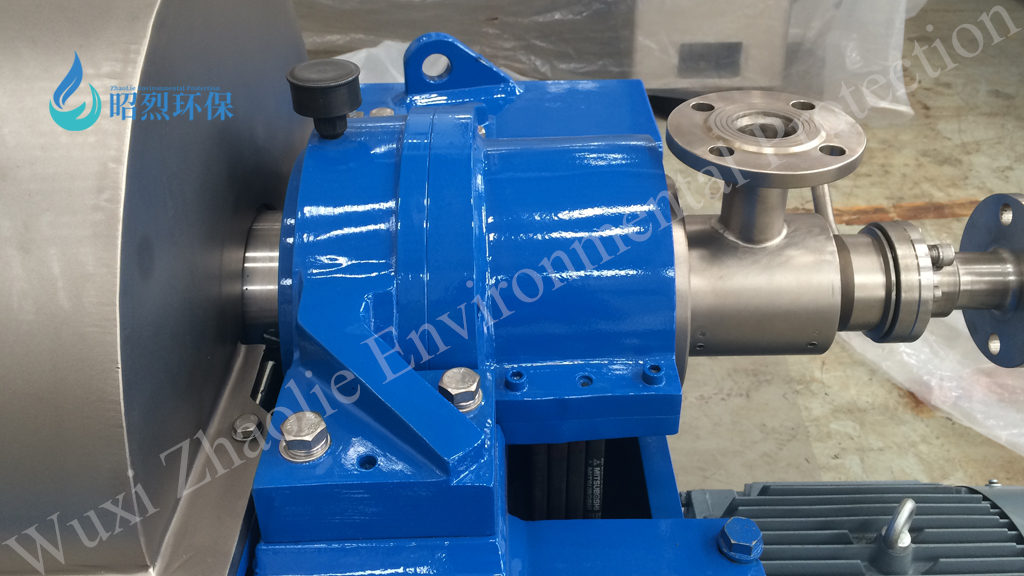
2.Cycloidal Pin-Wheel Differential
The cycloidal pin-wheel differential is a unique type of planetary transmission device, characterized by an internal gear drive wheel that employs a pin-wheel structure, while the planetary gears take the form of cycloidal wheels.
The structural components of this differential include left and right support bodies; a pin-gear housing fixed between these support bodies; input and output shafts rotatably mounted within the support bodies; and left and right eccentric cycloidal wheels arranged at a 180-degree offset.
Working Principle
Based on cycloidal pin-wheel transmission, the cycloidal wheel utilizes the inner equidistant curve of a shortened epicycloid as its tooth profile, while the pin wheel consists of a pin-tooth shell, pin-tooth pins, and pin-tooth bushings.
1.The left support member drives the pin housing and pin rollers to rotate around the input shaft;
2.The rotation of the pin-tooth pins accelerates the speed of the eccentric cycloidal wheel, thereby increasing the rotational speed of the output shaft;
3.The relationship between the number of pin-tooth pins and the number of teeth on the cycloidal wheel is defined by the formula N = 2(Z + 1), where N represents the number of pin-tooth pins and Z represents the number of teeth on the cycloidal wheel;
4.This design increases the driving torque exerted by the pin-tooth pins upon the cycloidal wheel, enabling a smaller cycloidal wheel to generate a greater torsional force.
The unique feature of the cycloidal pin-wheel drive lies in its planetary transmission principle; with the input and output shafts aligned on the same axis, it is characterized by stable operation and low noise levels.
The design features a high number of meshing cycloidal pin teeth and a large overlap coefficient, while the mechanism’s dynamic balancing design effectively mitigates vibration and noise. A single-stage transmission can achieve a reduction ratio of up to 9.97, high transmission efficiency.
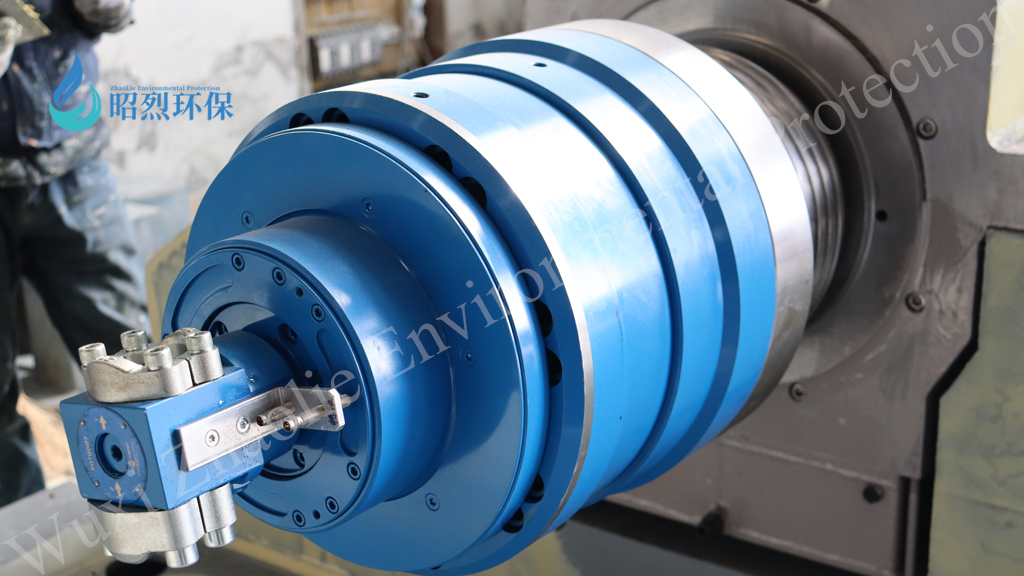
3.Hydraulic Differential
Hydraulic differential is a variable-displacement radial piston motor that generates a differential speed through a hydraulic system.
Working Principle
The pressure of the oil supplied from the pump station is transmitted to the piston balls via a cam plate; at the same time, the tangential force induces rotation of the rotor.
Through a distributor, pressure is supplied to the pistons, initiating their movement. The cylinders alternately apply the high pressure from the oil supply system to the differential mechanism, thereby driving the differential pistons and generating differential operation.
1.The differential unit is a rotating assembly mounted on the centrifuge rotor (screw conveyor), includes a cam plate, rotor, distributor, piston, and other components.
2.The pump station is the assembly responsible for powering the rotating unit,includes the hydraulic cylinder, hoses, cooling system, motor, and other components.
3.The control system achieves precise control of differential speed and system protection, includes the various sensors, controllers, and actuators.
The domestically produced hydraulic differential divides the assembly into two distinct components: the differential body and the rotary connector.
1.The differential body performs the actual differential function, while the rotary connector converts and transmits power from the hydraulic drive unit into the differential body.
2.The rotary connector employs a high-pressure, high-speed sealing structure, enabling the rotating shaft to operate at high pressures and speeds without incurring mechanical wear.
This modular design reduces the requirements for machining precision, allows for the independent maintenance and replacement of each functional unit, and thereby lowers overall maintenance costs.
Among imported hydraulic differentials, those from manufacturers such as Switzerland’s Vislong are high quality.
A comparative analysis of three types of centrifuge differentials reveals that each possesses its own distinct advantages and specific application scenarios. Based on usage trends for centrifuges both domestically and internationally, the planetary differential is the most widely adopted type, owing to its more mature technology, superior operational reliability, longer service life, and lower failure rate.