Is wastewater with high acidity/alkalinity and high salinity difficult to treat?
Wastewater characterized by high acid,alkali,and salt has long posed a challenge in industrial wastewater treatment due to its complex composition, high corrosivity, and the fact that microorganisms struggle to survive in it.
Therefore, treating such wastewater cannot rely on a single technology; instead, a combined process comprising “segregated pre-treatment, physicochemical desalination, and biochemical degradation” must be employed.
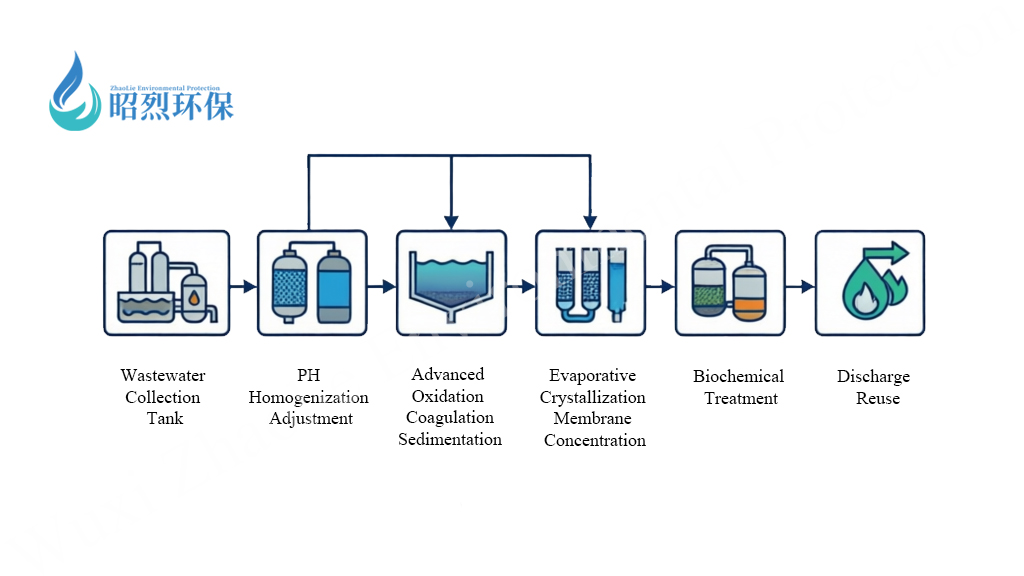
Process Flow
Wastewater Collection Tank ➔PH Homogenization & Adjustment ➔Advanced Oxidation & Coagulation-Sedimentation ➔ Evaporative Crystallization & Membrane Concentration ➔ Biochemical Treatment System ➔ Discharge / Reuse.
1.PH Homogenization & Adjustment
Direct entry of highly acidic or alkaline wastewater into the system can corrode equipment and kill the microorganisms required for subsequent biological treatment.
Working Principle: The process utilizes acid-base neutralization. Real-time monitoring via an online pH meter triggers the automatic dosing of acid (e.g., sulfuric acid) or alkali (e.g., sodium hydroxide) to adjust the wastewater pH to a neutral range of 6–9. Additionally, the adjustment tank balances water quality and flow rates, thereby preventing shock loads.
2.Advanced Oxidation & Coagulation-Sedimentation
High-salinity wastewater is often associated with refractory organic pollutants (COD).
Working Principle: Fenton oxidation or iron-carbon micro-electrolysis technology is employed. Strong oxidizing agents (such as hydroxyl radicals) are used to break down the long-chain structures of organic pollutants into smaller, readily biodegradable molecules, thereby enhancing the wastewater’s biodegradability. Subsequently, suspended solids and colloids are removed through coagulation sedimentation.
3.Evaporative Crystallization & Membrane Concentration
This step is critical for treating high-salinity wastewater. High salt concentrations cause microbial cells to dehydrate and die; therefore, desalination is required first.
Working Principle (Thermal Method): Employs MVR (Mechanical Vapor Recompression) or multi-effect evaporation technology. Thermal energy is used to evaporate water, causing salts to precipitate as crystals and enabling the separation of salt solids; the resulting condensate has a very low salt content and can be fed into the biochemical treatment system.
Working Principle (Membrane Method): For specific types of salts, reverse osmosis or electrodialysis can be used for concentration and volume reduction.
4.Biochemical Treatment
The desalinated water still contains residual organic matter and requires biochemical treatment.
Working Principle: Salt-tolerant bacterial strains are introduced. In an activated sludge system or a contact oxidation tank, the acclimated salt-tolerant microorganisms metabolize and break down organic pollutants in the water, using them as a nutrient source; these pollutants are ultimately converted into carbon dioxide and water, ensuring that discharge parameters—such as COD and ammonia nitrogen—meet regulatory standards.
This process employs physicochemical methods for desalination and biological methods for organic matter removal, making it currently the most mature and cost-effective solution for treating wastewater characterized by high acidity/alkalinity and high salinity.