Previously, we outlined the technical principles and structural characteristics of three common types of differentials used in decanter centrifuge; we will now examine their technical parameters and performance characteristics.
1.Planetary Differential
The technical parameters of the planetary differential cover a wide range: compatible drum diameters span 180–800 mm, drum speeds range from 3,500 to 5,500 rpm, the output differential speed is 2–80 rpm, and the separation factor can reach 4,400–5,500.
Regarding Torque Output: Differing differential specifications possess varying load-bearing capacities.
Model NB2.5 : Rated static load of 2,500 N·m.
Model NB5: Rated static load of 5,000 N·m; recommended operating speed of 3,500 rpm.
Model NB10: Rated static load of 10,000 N·m; recommended operating speed of 3,200 rpm; available transmission ratios: 25, 28, 29.5, 31.5, 35.5, 38, 40, 43, 45, 48, 50, 56, 57, 63, 71, 80, 91, 96, 100.
Model NB12: Rated static load of 12,000 N·m; recommended operating speed of 3,000 rpm; available transmission ratios: 112, 115, 131, 140, 154.
International Brands: Such as GEA CSE 30-35 series planetary differentials, featuring a torque range of 5–18 KN·m.
Domestic Brands: Certain differentials designed for decanter centrifuge applications offer a torque of 3,500N·m; specifically, the differentials paired with the model GNLW453D-VFD and GNLW454GT-VFD provide a torque of 7,500 N·m.
Regarding Transmission Efficiency: the planetary differential can achieve an efficiency of 0.99—a figure that ranks it at the forefront among all types of differentials.
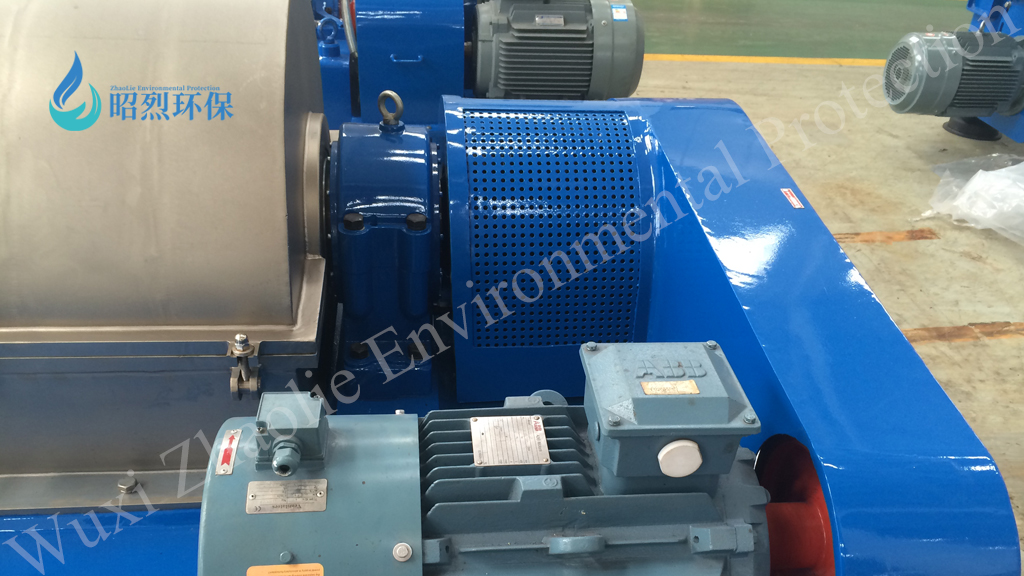
2.Cycloidal Pin-Wheel Differential
Due to their lower technical complexity and relatively lower cost, many decanter centrifuges utilize planetary cycloidal pin-wheel differentials. Their technical parameters tend to fall within a relatively concentrated range:
Regarding Torque Output:The torque output capacity of a cycloidal pin-wheel differential is relatively limited; consequently, it is suitable only for low-to-medium power decanter centrifuges.
Low-Power Decanter Centrifuges: Torque ≤ 2 kN·m; utilize grease lubrication.
Medium-Power Decanter Centrifuges: Depending on the specific model, torque ranges from several hundred to several thousand N·m.
High-Power Decanter Centrifuges: Due to structural limitations, this configuration is not suitable for high-power centrifuges.
Regarding Transmission Efficiency:The single-stage transmission ratio of the cycloidal pin-wheel differential reaches 9.97. Its transmission efficiency ranges from 0.9 to 0.95 (with some sources indicating figures as high as 0.97), and the differential speed is typically 15 r/min.
For Example:
1. Model 350 Decanter Centrifuge: BC22X; Output Torque: 1000 N·m; Dimensions: φ290 × 360 mm.
2. Model 450 Decanter Centrifuge: BC27X; Output Torque: 2000 N·m; Dimensions: φ350 × 400 mm.
3. Model 530 Decanter Centrifuge: BC33X; Output Torque: 4500 N·m; Dimensions: φ410 × 550 mm.
As indicated by the data above, the cycloidal pin-wheel differential occupies a relatively large volume for a given torque output; this constitutes one of its primary disadvantages.
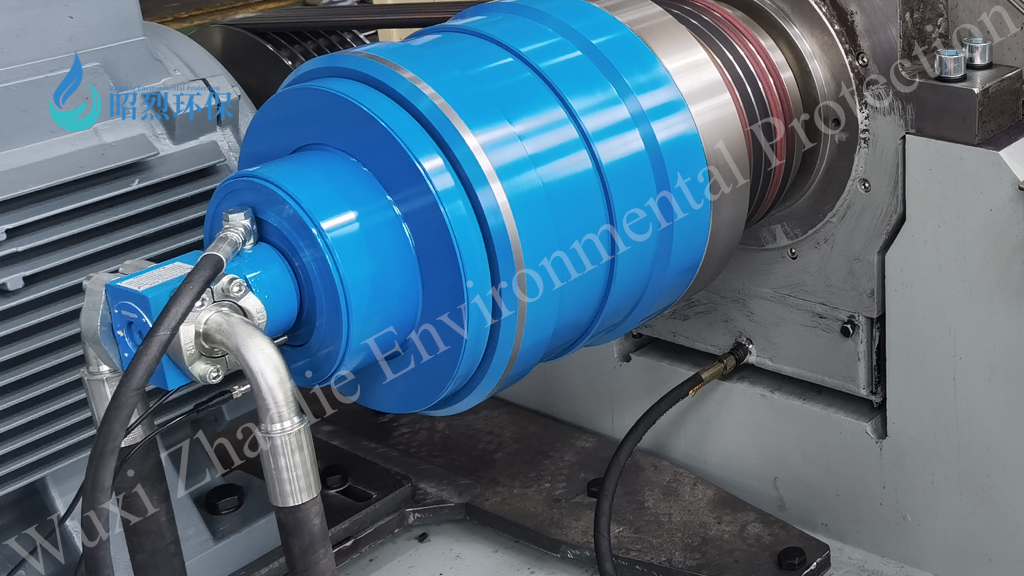
3.Hydraulic Differential
Hydraulic differentials possess significant advantages in terms of technical parameters; consequently, many major international brands are currently utilizing them.
Regarding Torque Output:The output torque is 2 to 3 times higher than that of a mechanical differential, typically reaching several thousand to tens of thousands of N·m—which is 2 to 4 times that of a standard motor-driven system.
1. Model 350 Decanter Centrifuge: YC3; Output Torque: 2800 N·m.
2. Model 450 Decanter Centrifuge: YC4; Output Torque: 3600 N·m.
3. Model 530 Decanter Centrifuge: YC5; Output Torque: 6000 N·m.
GEA Model UCD 536 (5-Stage Planetary + Hydraulic Coupling): Torque: 35 kN·m.
Regarding Transmission Efficiency:Differential speed range: 1–20 r/min (some sources indicate a range of 0.5–25 r/min); enables stepless automatic adjustment; allows for arbitrary adjustment of differential speed feedback control during operation; features an overload alarm output terminal and a maximum pressure alarm shutdown function.
Technical Features
1.Constant Torque Control: Features automatic torque feedback, automatic compensation, and automatic load adaptation.
2.Low Power: Characterized by reduced decanter centrifuge bowl load and significant energy-saving effects.
3.Single/Double-Row Inner-Curve Radial Plungers: Delivers high output torque—2 to 3 times greater than that of mechanical-type systems.
4.Pressure Protection Device: Equipped with a safety valve that opens in the event of system overload, ensuring the safety of the equipment.
5.Automatic Differential Speed Acceleration: In the event of an overload or blockage during the solids discharge process, the system automatically accelerates the differential speed and compensates for power output; the wide range of differential speed feedback compensation effectively prevents material blockages.
6.Specialized Function: Enables hydraulic sludge discharge even while the decanter centrifuge bowl is stationary, eliminating the need for mechanical disassembly for cleaning and facilitating convenient troubleshooting.