Wastewater from brewery is primarily characterized by high concentrations of organic matter, high levels of suspended solids, and significant fluctuations in water quality. If discharged directly, it would severely disrupt the aquatic ecosystem.
The key to treating this type of wastewater lies in combining “resource utilization” with “multi-stage degradation.”
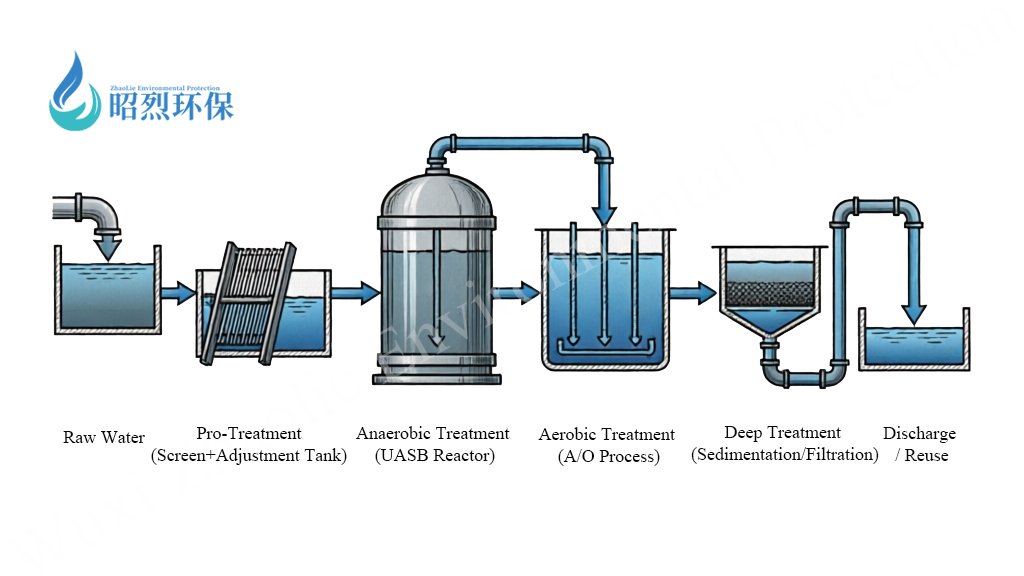
Process Flow
Raw Water ➔ Pre-Treatment (Screen + Adjustment Tank) ➔ Anaerobic Treatment (UASB Reactor) ➔ Aerobic Treatment (A/O Process) ➔ Deep Treatment (Sedimentation/Filtration) ➔ Discharge / Reuse
1.Pre-Treatment (Screen + Adjustment Tank)
Wastewater from breweries contains a significant volume of large-particle suspended solids—such as malt husks and spent grains—and exhibits substantial variability in water quality across different discharge batches.
1. Mechanical screens are employed to intercept large solid particles, thereby preventing blockages in downstream pipelines and pumps.
2. The wastewater then flows into a equalization tank, where both its flow rate and water quality are homogenized. Additionally, neutralization reactions are utilized to adjust the pH level to a range of 6–9, thereby mitigating acidic shock and ensuring the stable operation of the subsequent biochemical treatment system.
2.Anaerobic Treatment (UASB Reactor)
This constitutes the core stage of the brewery wastewater treatment process, primarily designed to remove high concentrations of COD.
Utilizing Upflow Anaerobic Sludge Blanket (UASB) technology
In an oxygen-free environment, anaerobic microorganisms decompose high-concentration organic matter (such as sugars and alcohols) present in wastewater into methane (biogas) and carbon dioxide.
This process not only removes 80% to 90% of organic pollutants, but the generated biogas can also be recovered for power generation or boiler heating, thereby transforming waste into valuable resources.
3.Aerobic Treatment (A/O Process)
The anaerobic effluent still contains a portion of organic matter and ammonia nitrogen, requiring further degradation.
Utilizing Anoxic-Aerobic (A/O) Process
In the anoxic stage, denitrifying bacteria are utilized to convert nitrate nitrogen into nitrogen gas, thereby achieving nitrogen removal;
In the aerobic stage, oxygen is supplied through aeration, and aerobic microorganisms (activated sludge) are utilized to thoroughly oxidize and decompose the remaining organic matter into carbon dioxide and water, while also removing ammonia nitrogen.
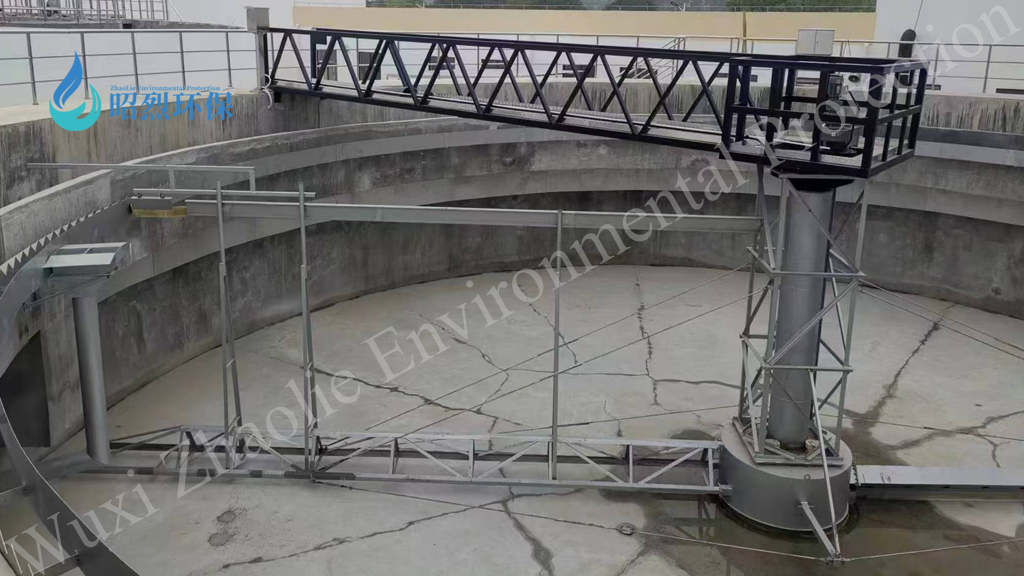
4.Deep Treatment (Sedimentation/Filtration)
Ensure that the final effluent is clear and that all parameters consistently meet established standards.
The effluent from the aerobic tank enters the secondary sedimentation tank for solid-liquid separation; the supernatant then undergoes filtration or coagulation-sedimentation to further remove fine suspended solids (SS) and total phosphorus.
Finally, following disinfection to eliminate pathogenic bacteria, the quality of the effluent is ensured to meet discharge or reuse standards.
Through three-stage synergistic approach—comprising “pretreatment for load reduction,” “anaerobic biogas production for energy conservation,” and “aerobic biochemical purification”—this water treatment process not only resolves the pollution issues associated with brewery wastewater but also achieves the recovery and utilization of energy.